

 Tech Docs
 FAQ
FAQCompensation wire introduction
Thermocouple Extension Wire
Compensation wires are dedicated wires used to connect the thermocouple sensing end to measurement or control equipment (such as temperature controllers and data recorders). Their main function is to stably transmit the thermoelectric potential signal generated by the thermocouple to the downstream system to ensure the accuracy of the temperature reading.
Based on their material and precision level, compensation wires can be broadly classified into two types:
-
Extension Grade (Thermocouple-grade wire)
The conductor material is the same as the thermocouple body, and has the same thermoelectric properties, so it can be used in a higher temperature range and can provide higher measurement accuracy.
-
Compensating Cable
It uses a lower-cost alloy material to simulate the thermoelectric properties of thermocouples, making it suitable for lower temperature environments. Its accuracy is slightly lower than that of extended-range thermocouples, but it is sufficient for general industrial applications.
Precautions for using compensation wires:
When selecting compensation wires, it is essential to ensure that the conductor material is compatible with the corresponding thermocouple type (e.g., K-type, J-type, T-type). Using incompatible materials may result in additional thermoelectric potential, thereby affecting the measurement results.
In addition, the compensation wire and thermocouple should have similar thermoelectric properties and temperature range to reduce errors during signal transmission and ensure the stability and accuracy of the overall measurement system.
Characteristics of insulation material for compensation conductors:
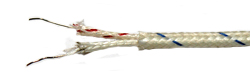
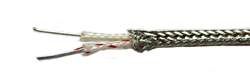
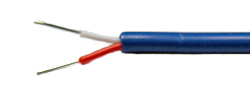
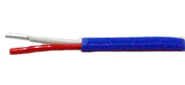
Besides the conductor material, the insulation material is also an important factor affecting the performance of compensation wires. Different insulation materials will directly affect their temperature range, flexibility, chemical resistance and service life.
Choosing the right insulation material can effectively improve the reliability and service life of wires in different industrial environments.
Compensation wire insulation material and characteristics reference
(Please refer to the specifications of each model for details)
| Kinds | Applicable temperature | Non-flammable | Wear resistance | Organic solvent | Acid resistance | Moisture resistance | Flexibility |
|---|---|---|---|---|---|---|---|
| Plastic (PVC) | -20°C~105°C | Difference | Good | Difference | Good | Good | Excellent |
| Teflon(FEP) | -200°C~200°C | Good | Excellent | Excellent | Excellent | Excellent | Good |
| Teflon (PFA) | -267°C~260°C | Good | Excellent | Excellent | Excellent | Excellent | Good |
| KAPTON | -267°C~316°C | Good | Excellent | Good | Good | Good | Good |
| Fiberglass (Japanese standard) | Room temperature~270°C | Excellent | Possible | Excellent | Excellent | Difference | Possible |
| Fiberglass (US regulations) | -73°C~482°C | Excellent | Possible | Excellent | Excellent | Difference | Possible |
| High temperature resistant ceramic fiber | -17°C~1200°C | Excellent | Difference | Excellent | Possible | Difference | Possible |
American wire gauge (AWG) size comparison table
| Gage No. | Wire diameter (mm) |
Cross-sectional area(mm2) | Gage No. | Wire diameter (mm) |
Cross-sectional area(mm2) | Gage No. | Wire diameter (mm) |
Cross-sectional area(mm2) | Gage No. | Wire diameter (mm) |
Cross-sectional area(mm2) | Gage No. | Wire diameter (mm) |
Cross-sectional area(mm2) |
|---|---|---|---|---|---|---|---|---|---|---|---|---|---|---|
| 1 | 7.348 | 42.4 | 9 | 2.906 | 6.63 | 17 | 1.150 | 1.04 | 25 | 0.455 | 0.162 | 33 | 0.180 | 0.0254 |
| 2 | 6.544 | 33.6 | 10 | 2.588 | 5.26 | 18 | 1.024 | 0.823 | 26 | 0.405 | 0.129 | 34 | 0.160 | 0.0201 |
| 3 | 5.827 | 26.7 | 11 | 2.305 | 4.17 | 19 | 0.912 | 0.653 | 27 | 0.261 | 0.102 | 35 | 0.143 | 0.0160 |
| 4 | 5.189 | 21.2 | 12 | 2.053 | 3.31 | 20 | 0.812 | 0.518 | 28 | 0.321 | 0.0810 | 36 | 0.127 | 0.0127 |
| 5 | 4.621 | 16.8 | 13 | 1.828 | 2.62 | 21 | 0.723 | 0.410 | 29 | 0.286 | 0.0642 | 37 | 0.113 | 0.0100 |
| 6 | 4.115 | 13.3 | 14 | 1.628 | 2.08 | 22 | 0.644 | 0.326 | 30 | 0.255 | 0.0509 | 38 | 0.101 | 0.00797 |
| 7 | 3.665 | 10.5 | 15 | 1.450 | 1.65 | 23 | 0.573 | 0.258 | 31 | 0.227 | 0.0404 | 39 | 0.0897 | 0.00632 |
| 8 | 3.264 | 8.37 | 16 | 1.291 | 1.31 | 24 | 0.511 | 0.205 | 32 | 0.202 | 0.0320 | 40 | 0.0799 | 0.00501 |
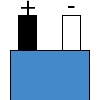
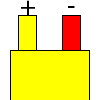
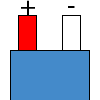
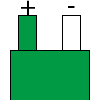
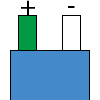
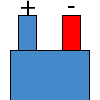
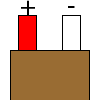
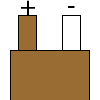
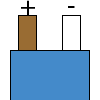
Color specifications for compensation wires and connecting plugs
| ANSI plug | ANSI/ ASTM E-230 prime line grade | ANSI/ASTM E-230 compensation grade | JIS C 1610-1989 | IEC 584-3 line level | IEC 584-3 compensation level | IEC 584-3 plug |
| J | 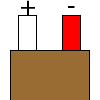 |
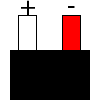 |
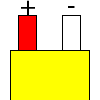 |
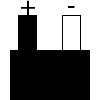 |
 |
J |
| K | 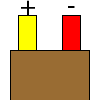 |
 |
 |
 |
 |
K |
| T | 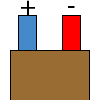 |
 |
 |
 |
 |
T |
| E | 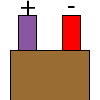 |
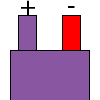 |
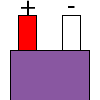 |
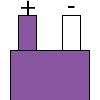 |
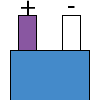 |
E |
| N | 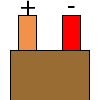 |
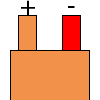 |
no specification | 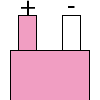 |
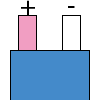 |
N |
| R | no specification | 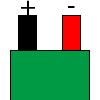 |
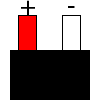 |
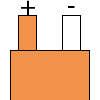 |
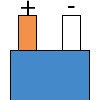 |
R |
| S | no specification | |
|
|
|
S |
| B | no specification | 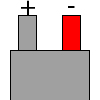 |
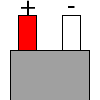 |
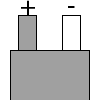 |
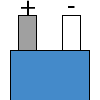 |
B |


